
What Will $500/Month Be Worth in 10, 20, and 30 Years?
What will $500/month be worth in 10, 20, and 30 years? See projected balances at 7%, total contributions, and how compounding changes the outcome over time.
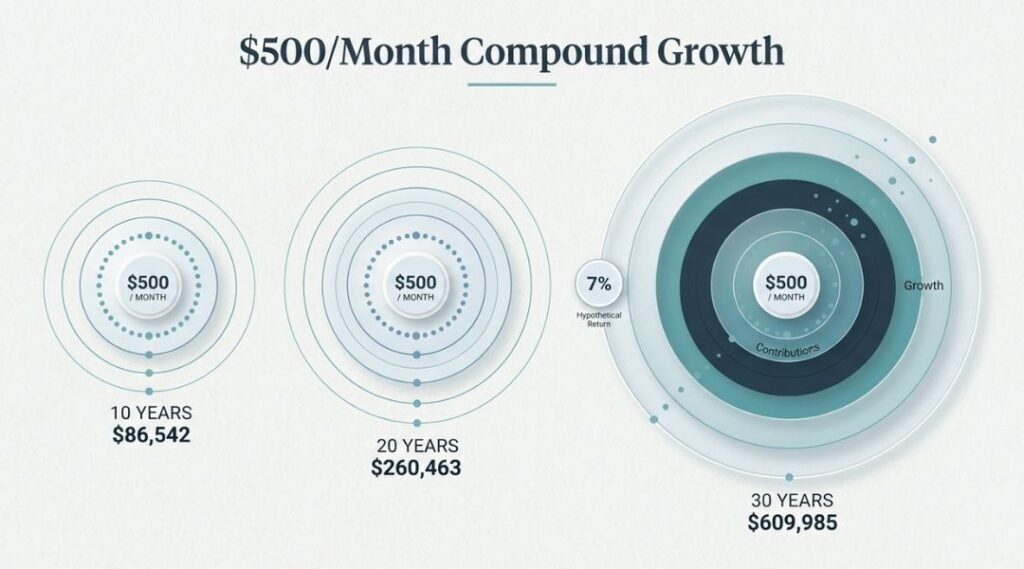
What Will $500/Month Be Worth in 10, 20, and 30 Years? It may not seem to be a big deal to save or invest $500 per month at first. However, allow these contributions to compound over a prolonged period, and the numbers can significantly change.
If you invest $500 in the account at the end of each month and your balance is projected to grow by a hypothetical 7% annually compounded monthly, then at the end of the month, you would have approximately:
| Time | Amount Contributed | Projected Value | Investment Growth |
| 10 years | $60,000 | $86,542 | $26,542 |
| 20 years | $120,000 | $260,463 | $140,463 |
| 30 years | $180,000 | $609,985 | $429,985 |
These are projections, not guaranteed investment outcomes.
Why Does $500 a Month Grow So Much?
The answer is compound growth.
Your early contributions have years to potentially earn returns. Those returns can then generate additional returns of their own. Investor.gov describes compound growth as earning a return on both your original investment and the returns it has already generated.
Notice what happens over 30 years: you personally contribute $180,000, yet the hypothetical balance reaches roughly $610,000.
This same long-term compounding approach can also be used when estimating retirement savings growth.
The difference comes from time and compounding.
How Is the Future Value Calculated?
For regular monthly contributions, a common future value of an annuity calculation is::
FV = PMT × [((1 + r)^n − 1) ÷ r]
Where:
- PMT = monthly contribution
- r = monthly rate of return
- n = total number of monthly contributions
Investor.gov’s compound interest calculator similarly factors in monthly contributions, time, estimated interest rate, and compounding frequency.
What If Your Return Is Different?
The assumed return has a major impact.
After 30 years of investing $500 monthly, the approximate result would be:
- 5% return: $416,129
- 7% return: $609,985
- 9% return: $915,372
That wide range is why it is better to test several return assumptions instead of planning around one number. The same approach is useful when setting a long-term monthly savings goal for other financial objectives.
Remember Fees, Taxes, and Inflation
Actual investment results may also be reduced by fees, taxes, and inflation. Markets do not deliver a fixed return every month or every year, either.
Investor.gov emphasizes that investments involve risk and market fluctuations, even when long-term historical averages are used for planning.
The Bottom Line
So, what will $500/month be worth in 10, 20, and 30 years? It would amount to about $86,542 in 10 years, $260,463 in 20 years, and $609,985 in 30 years at a hypothetical return rate of 7% compounded monthly.
The larger point is that there’s an increasing amount of time that does the work. As the investment time frame increases, the potential compound effect can become much greater, but it never goes away, and your contribution is always necessary.

An Accounting & Finance graduate currently pursuing an advanced Master’s in accounting and finance degree at Teesside University (UK), Anfal leads our rigorous quality assurance pipeline. She systematically audits the algorithmic calculations behind our tools, cross-checking every output against institutional benchmarks and academic financial literature to eliminate calculation drift.