
How to Calculate Future Value of an Annuity
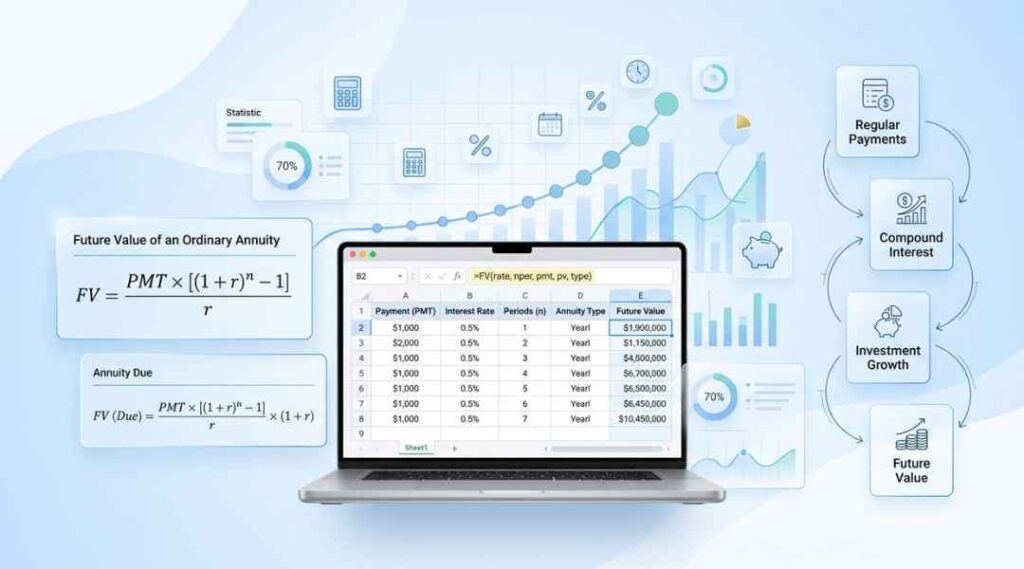
A certain amount of money that you pay at a specific time when it comes to household budgets, retirement savings, pension plans, loan payments, and insurance claims. If you are considering saving for an investment that pays out in the future, using a method called the future value of an annuity. It tells you exactly how much this payment stream will amount to once it stops growing.
What Is the Future Value of an Annuity?
The Future value of an annuity (FVA) is the total amount, at a future time in terms of cash, upon the successful completion of a series of regular payments when each payment receives a fixed level-rate return (interest) for every period. It includes the payments as well as the interest that accrues on it over time.
There are two fundamental types of annuities, and the calculation is different to some degree for each:
- Ordinary annuity Payments are made at the end of each period.
- Annuity due: Payments are made at the beginning of each period.
The Future Value of an Annuity Formula
For an ordinary annuity, the formula is:
FV = PMT × [(1 + r)^n − 1] / r
For an annuity due, you multiply the result by an extra factor of (1 + r), since each payment earns one additional period of interest:
FV (due) = PMT × [(1 + r)^n − 1] / r × (1 + r)
Where:
- PMT = the amount of each periodic payment
- r = the interest rate per period
- n = the total number of payments
You can also use future value calculators to test different payment amounts, rates, and time periods without calculating the formula manually.
Worked Example: Ordinary Annuity
If you invest $500 every year (at the end of each year) in an investment earning 5% annual interest, how much will be in your account after 15 years?
FV = 500 × [(1 + 0.05)^15 − 1] / 0.05
FV = 500 × [1.05^15 − 1] / 0.05
FV = 500 × [2.0789 − 1] / 0.05
FV = 500 × 21.579
FV = $10,789.28
After 15 years, you have contributed approximately $10,789.
Worked Example: Annuity Due
Let us now assume that the payments of $500 above are made at the beginning of every year for a total of N = 7 years:
FV (due) = 10,789.28 × (1 + 0.05)
FV (due) = $11,328.75
Each payment compounds for an additional year, which adds about $539 to the total.
Calculating Future Value of an Annuity in Excel
You don’t need to work the formula by hand. Excel’s FV function does it instantly:
=FV(rate, nper, pmt, [pv], [type])
For the ordinary annuity example above:
=FV(5%, 15, -500)
For the annuity due version, set the type argument to 1:
=FV(5%, 15, -500, 0, 1)
Read More about: How to calculate Future value in Excel?
Why This Calculation Matters
These calculations allow you to determine how regular, recurring payments to a 401(k) or an IRA will compound over many decades. They are also used to value fixed income investments, structure loan repayment schedules, and analyze savings plan comparisons.
For a practical example of how monthly contributions can grow over time, consider how a consistent $500 monthly investment changes over 10, 20, and 30 years.
If you really want to go in depth regarding annuity valuation, present value comparison, and how annuities fit into the overall retirement planning Fidelity’s model has prepared a booklet on various aspects of annuities that would leave no stone unturned by one of the largest financial services firms in existence.
Final Thoughts
Regardless of whether you calculate by hand or via Excel’s FV function, understanding the future value of an annuity gives you a concrete, quantitative frame to see how repeated saving and compound interest interact. The thing is, even slight variations in interest rates, contribution amounts, or timing of deposits can have a big impact on your final balance, which is why it pays to run the numbers before you lock into a savings or investment strategy.

An Accounting & Finance graduate currently pursuing an advanced Master’s in accounting and finance degree at Teesside University (UK), Anfal leads our rigorous quality assurance pipeline. She systematically audits the algorithmic calculations behind our tools, cross-checking every output against institutional benchmarks and academic financial literature to eliminate calculation drift.