
Daily vs. Monthly Compounding: What’s the Difference?
Daily vs. monthly compounding explained: see how often interest is added, how much the difference can be, and why APY matters when comparing accounts.
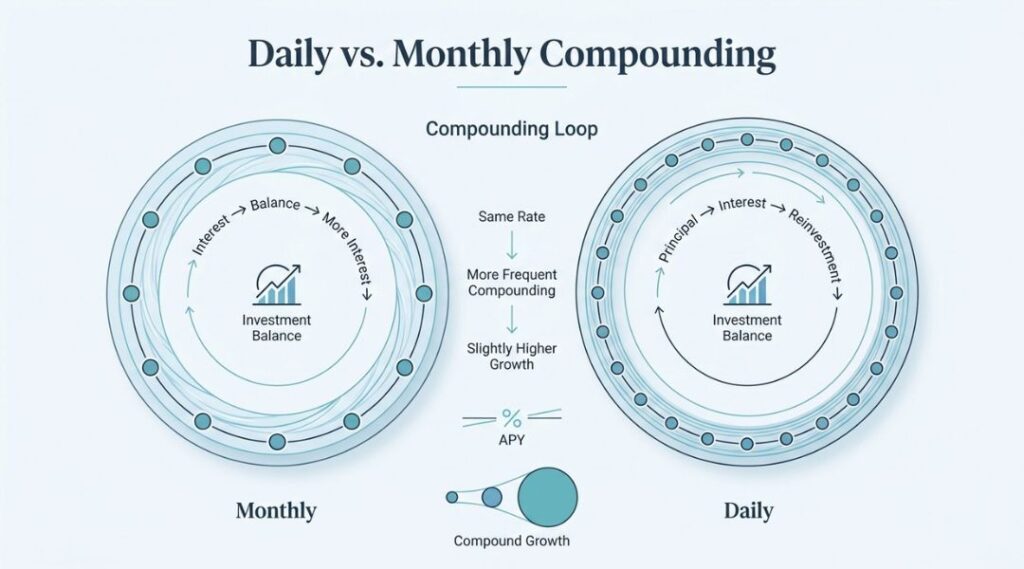
If two accounts are offering the same interest rate, the one that has a higher number of compoundings will result in slightly more money for the account. The basic difference between Daily vs. Monthly Compounding is that in the daily one, the compounding takes place every day, while in the monthly one, it takes place every month.
Daily compounding provides earned interest with an increased chance to earn further interest. In reality, the advantage is not as great as it is sometimes thought to be.
Here is a comparison of the two approaches, and what is really important to consider when deciding on one over the other.
How Daily and Monthly Compounding Work
Compound interest is commonly calculated using:
FV = P × (1 + r/n)^(nt)
Where:
- P = starting principal
- r = annual interest rate
- n = number of compounding periods per year
- t = number of years
OpenStax notes that account value rises as compounding frequency increases when the other variables remain the same. This relationship between frequency and growth is important when understanding how compounding frequency affects future value.
Monthly Compounding
With monthly compounding, interest is compounded 12 times per year. Each month’s interest becomes part of the balance used to calculate future interest.
Daily Compounding
With daily compounding, interest is typically compounded 365 times per year. Interest therefore begins earning additional interest sooner.
Daily vs. Monthly Compounding Example
Suppose you deposit $10,000 at a 5% nominal annual rate and leave it untouched for 10 years.
Assuming no fees or withdrawals:
- Monthly compounding: about $16,470
- Daily compounding: about $16,487
- Difference: about $17
Daily compounding wins, but not by a dramatic amount.
The gap can become larger with higher rates, bigger balances, and longer time periods, although increasingly frequent compounding produces diminishing additional gains.
Why APY Matters More Than Compounding Frequency
When comparing savings accounts or CDs, don’t look at compounding frequency by itself.
The annual percentage yield (APY) already reflects both the stated interest rate and how frequently interest compounds. The CFPB specifically defines APY this way.
That means an account compounding monthly could still produce a better return than one compounding daily if its APY is higher.
Compare These Factors Instead
When evaluating accounts, look at:
- APY
- Fees
- Minimum-balance requirements
- Withdrawal restrictions
- Whether the rate is fixed or variable
A tiny compounding advantage can easily be outweighed by a lower rate or recurring fee.
The Bottom Line
So, in daily vs. monthly compounding, daily compounding generally produces a future value that is slightly larger than in the case of monthly compounding, if the same principal, nominal interest rate, and time period are applied to both.
However, “frequency” isn’t always everything.
When using our future value calculator, compare the accounts on a mathematical basis using both compounding schedules, but for a real financial comparison, also consider APY, fees, and account terms.

An Accounting & Finance graduate currently pursuing an advanced Master’s in accounting and finance degree at Teesside University (UK), Anfal leads our rigorous quality assurance pipeline. She systematically audits the algorithmic calculations behind our tools, cross-checking every output against institutional benchmarks and academic financial literature to eliminate calculation drift.