Future Value Calculator | Get Time Value of Money Today at a Single Click
Use our free Future Value Calculator to estimate how much your investments, savings, or retirement contributions could grow over time. Our FV Calculator helps you calculate your money investment growth plan using compound interest, monthly contributions, and inflation-adjusted projections. Get your estimations instantly, accurately, and for free.
All data verified through Google Scholar Research Papers
Written and audited by a person doing Masters in Accounting & Finance

Future Value Calculator
Enter your numbers — all projections update instantly. No button required.
Your Numbers
Your Projection
Growth Over Time
Compounding Frequency Comparison
Year-by-Year Breakdown
| Year | Future Value | Total Invested | Interest Earned | Real Value | Growth |
|---|

Future Value Projection
What Is Future Value?
This is the projected value of a sum of money at a later date, under a given rate of increase. It can help investors predict what a current investment might be worth in the future.
One of the most important concepts in personal finance and personal investments is that of FV. It simply lets you know what your money will be worth in the future, given the rewards you will be receiving in the form of interest or investment gains.
This concept is known as the time value of money, which is expressed as the idea that a dollar today is worth more than another dollar in the future due to its earning potential. This single idea drives every smart financial decision – from saving for retirement to comparing investment options (Dahlquist & Knight, 2026)5.
How you can get help from future value calculations:
- Know exactly how much your savings will grow
- Compare investment options with real numbers
- See the true cost of delaying savings
- You can plan for retirement, education, or any financial goal
- Take advice from the Financial Planner After doing Time value of money calculations.

How Does a FV Calculator Work?
fv calculator applies the Time value of money concept to your inputs. We use principal, interest rate, time, and contribution returns to return your projected future balance, including a breakdown of principal vs. interest earned (Dahlquist & Knight, 2026)5.
|
Input |
What It Means |
|---|---|
|
Present Value (PV) |
Your starting amount – initial deposit or current balance |
|
Annual Interest Rate |
Expected yearly return (savings APY, investment return, etc.) |
|
Time Period |
How many years you plan to invest or save |
|
Monthly Contributions |
Regular amount added each month (optional) |
|
Inflation Rate |
Expected annual inflation for real-value projection (optional) |
Enter your numbers, select your compounding frequency, and the calculator instantly shows your future balance – along with a year-by-year growth table and chart showing exactly how your money accumulates
Future Value Formula
These formulas are
Lum Sum Future Value Equation:
The standard future value formula for a single investment is:
Where:
- FV = Future Value
- PV = Present Value (starting amount)
- r = Interest rate per period (as a decimal)
- n = Number of periods
Example: You invest $10,000 at 7% annual return for 20 years:
FV = 10,000 × (1.07)²⁰
FV = 10,000 × 3.8697
FV = $38,697
Your $10,000 nearly quadruples in 20 years – without adding a single dollar. That is the FV formula at work.
Future Value of Annuity Formula
When you make regular contributions – monthly savings, annual deposits – the future value of annuity formula applies (Dahlquist & Knight, 2026)5
Where:
- PMT = Payment per period
- r = Interest rate per period
- n = Total number of periods
Example: You save $400/month at 7% annual return (0.5833% monthly) for 30 years (360 months):
FV = 400 × [((1.005833)³⁶⁰ – 1) / 0.005833]
FV = 400 × 1,019.15
FV = $487,988
You contributed $144,000 total. Compound interest generated the remaining $343,988 – nearly double your contributions – entirely through consistent saving over time.
Future Value Equation Fully Explained
Future Value of a Single Investment
Your initial deposit compounding over time. The same rate per period and total periods apply regardless of compounding frequency chosen.
Future Value of Periodic Contributions
Your recurring deposits compounding over time. This is an ordinary annuity — each payment is made at the end of each period. When the rate equals zero, FVpmt = PMT × N.
Total Future Value
The headline number — sum of both components. Both use the same frequency. Rate per period is always r/f and total periods is always f × t. Never mixed.
Also: Total Invested = PV + PMT × f × t · Interest Earned = FVtotal − Total Invested
Inflation-Adjusted (Real) Value
Nominal future value discounted by cumulative annual inflation. Shows what your future balance is worth in today’s purchasing power — essential for retirement planning.
Formula Audit Trail
✔️ What This Calculator Assumes
- Constant annual return rate throughout the investment period
- Constant contribution amount per compounding period
- Payments at the end of each period (ordinary annuity)
- Same compounding frequency applied to both PV and PMT
- Annual inflation applied once per year to compute real value
❌ What This Calculator Does Not Model
- Taxes on capital gains or dividends
- Variable or sequence-of-returns risk
- Investment management fees or expense ratios
- Changing contribution amounts over time
- Currency, sovereign, or country-specific tax risk
OUR METHADOLOGY
How We Ensure Formula Accuracy?
We are following this process to get things in a right way
Academic Foundations
Every algebraic expression is sourced directly from institutional finance textbooks, Myers & Allen; Ross, Westerfield & Jordan; Bodie, Kane & Marcus, and peer-reviewed articles indexed on ResearchGate. All attribution is tracked and linked on this page.
Editorial Review
Our editorial Author Masters in Accounting and Finance systematically cross-checks every calculation line in our codebase to isolate and mitigate logical outliers. The audit covers rate-period matching, zero-rate edge cases, and inflation discounting accuracy.
50–70 Student UX Testing
We pilot every interface through a core testing pool of 50–70 higher-education students across universities in the USA, UK, and Pakistan to optimize readability, clear out confusing jargon, and verify results against students’ own manual coursework calculations.
FINANCE Concepts
Key Concepts For FV Calculator
Here is the fundamental rules behind the future value calculations if you are business owner or a student you must know the following concepts that corealtes with the Time value of money and future savings.
Time Value of Money
A dollar today is worth more than a dollar tomorrow because money available now can be invested and earn returns. This principle drives every future value calculation. All FV formulas are a direct application of TVM.
Compound Interest
Interest calculated on both principal and all previously accumulated interest. Each period’s interest base grows larger than the last. The longer the horizon, the more powerful the effect.
Ordinary Annuity
A series of equal payments made at the end of each period. This is the standard assumption for savings plans and the model this calculator uses. Payments at the beginning would use the annuity-due formula.
Compounding Frequency
How often interest is calculated and added to your balance. Monthly compounding produces more than annual compounding at the same stated rate because interest begins earning interest more quickly.
Inflation & Real Value
Nominal FV tells you how many dollars you will have. Real value tells you what those dollars can actually buy. A 3% annual inflation rate roughly halves purchasing power over 24 years.
FV vs. Present Value
Future value projects a present sum forward in time. Present value reverses the process: PV = FV ÷ (1 + r/f)^(f×t). They are two sides of the same time value of money equation.
How to Calculate Future Value
To compute, you must know the present value, interest rate, and length of time of investment and use the formula: FV = PV × (1 + r)ⁿ. If a monthly savings amount is required, you may need to use the annuity formula or our calculator to instantly determine your monthly savings (Dahlquist & Knight, 2026)5.
Steps Used to Calculate FV of an Investment
Follow these steps to calculate the FV of an investment manually or to understand what our calculator is doing:
Identify your Present Value – the money you are investing today.
Choose your interest rate – be realistic. Use 7% for a diversified stock portfolio, 4–5% for high-yield savings, 3–5% for bonds.
Set your time horizon – how many years until you need the money.
Add monthly contributions if you plan to save regularly.
Select compounding frequency – monthly is most common for savings and investment accounts.
Apply the formula – or simply use our calculator and read the instant result.
Lump Sum Future Value – What Different Amounts Become
|
Lump Sum |
10 Years |
|
30 Years |
|
|---|---|---|---|---|
|
$5,000 |
$9,836 |
$19,348 |
$38,061 |
|
|
$10,000 |
$19,672 |
$38,697 |
$76,123 |
|
|
$25,000 |
$49,179 |
$96,742 |
$190,306 |
|
|
$50,000 |
$98,358 |
$193,484 |
$380,613 |
|
|
$100,000 |
$196,715 |
$386,968 |
$761,226 |
Time is greater than the initial investment. An investment of $10,000 that lasts for 30 years will result in a higher yield than an investment of $50,000 in just 10 years (Dahlquist & Knight, 2026)5.
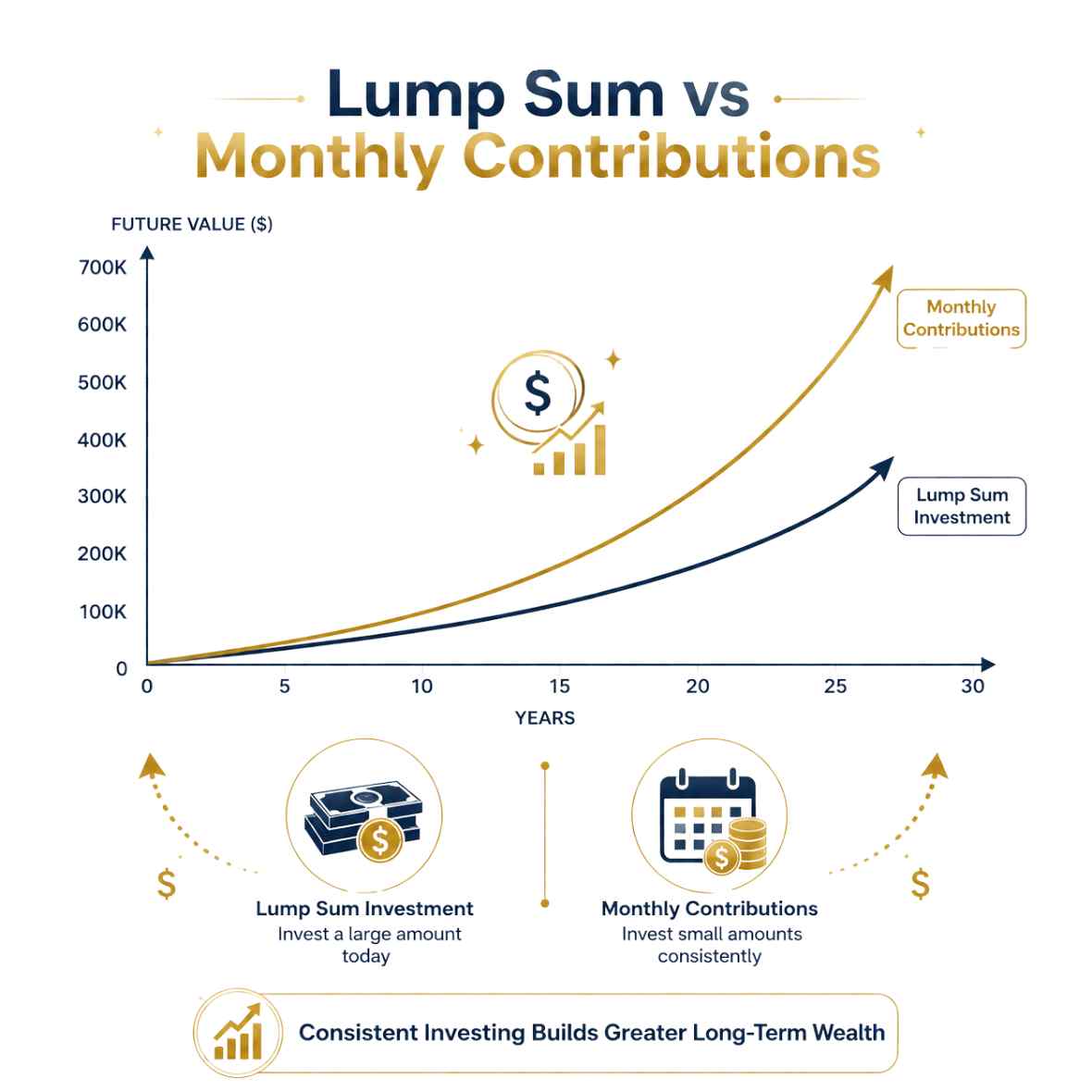
Future Value with Monthly Contributions
|
Years |
Total Contributed |
|
Interest Earned |
|
|---|---|---|---|---|
|
10 |
$60,000 |
$86,835 |
$26,835 |
|
|
20 |
$120,000 |
$260,464 |
$140,464 |
|
|
30 |
$180,000 |
$606,438 |
$426,438 |
|
|
40 |
$240,000 |
$1,311,828 |
$1,071,828 |
At 40 years, over $1 million of the final balance is pure interest – money earned on money, repeatedly, over time. The contributions themselves account for less than 20% of the total (Dahlquist & Knight, 2026)5.
Practical Use Cases – Real Scenarios
Retirement Planning
A 30-year-old with $15,000 in savings contributes $600/month at 7% annual return until age 65 (35 years):
- Lump sum FV: $15,000 × (1.07)³⁵ = $160,149
- Monthly contributions FV: $600/month × annuity factor = $1,080,633
- Total at retirement: ~$1,240,781
Starting with just $15,000 and $600/month – less than many people spend on dining out – produces over $1 million at retirement. The earlier you start, the less you need to contribute to reach the same goal.
Education Fund Planning
Parents saving for a child’s college education can use the future value calculator to determine exactly how much to save monthly to hit a target fund in 18 years.
At 6% return, to reach a $120,000 education fund in 18 years with no initial lump sum:
Required monthly contribution ≈ $376/month
At 7% return, the same goal requires only:
Required monthly contribution ≈ $309.79/month
A single percentage point difference in return saves $39/month – or over $8,400 across 18 years. This is why choosing the right savings vehicle for your education fund matters as much as how much you contribute.
Comparing Two Investment Options
|
Option |
Rate |
|
|
|---|---|---|---|
|
High-Yield Savings (4%) |
4% annual |
$21,911 |
|
|
Index Fund (8%) |
8% monthly |
$49,268 |
The index fund produces more than double the future value over the same period. Quantifying this difference – rather than guessing – is exactly what a future value calculator is designed to do.
FV Calculator with Inflation
An inflation-adjusted FV divides your nominal result by (1 + inflation rate)ⁿ to show what your future money is worth in today’s purchasing power – essential for retirement planning (U.S. Securities and Exchange Commission [SEC], n.d.-a)7.
Nominal future value tells you how many dollars you will have. Real future value tells you how much those dollars will actually buy. The difference over decades is enormous (SEC, n.d.-a)7.
Formula:
Example: Your portfolio is projected to reach $800,000 in 30 years. With 3% annual inflation:
Real FV = 800,000 ÷ (1.03)³⁰
Real FV = 800,000 ÷ 2.4273
Real FV = $329,590
In today’s purchasing power, your $800,000 is actually worth about $330,000. This is why inflation-adjusted projections are essential – and why our calculator shows both values side by side.
Real vs. Nominal Returns
|
Nominal Return |
Inflation |
|
|
|---|---|---|---|
|
10% |
3% |
~7% |
|
|
7% |
3% |
~4% |
|
|
5% |
3% |
~2% |
|
|
3% |
3% |
~0% |
A savings account earning 3% during 3% inflation is producing zero real growth. Always use the real return rate when projecting in today’s dollars (SEC, n.d.-a)7.
Future Value vs Present Value
Future value tells you what money today will be worth later. Present value is the reverse – it tells you what a future sum is worth in today’s dollars. They are two sides of the same time value of money equation (Dahlquist & Knight, 2026)5.
|
. |
Future Value (FV) |
|
|
|---|---|---|---|
|
Question it answers |
How much will my money grow to? |
How much do I need today to reach a goal? |
|
|
Direction |
Present → Future |
Future → Present |
|
|
Formula |
FV = PV × (1 + r)ⁿ |
PV = FV ÷ (1 + r)ⁿ |
|
|
Use case |
Investment growth projection |
Goal-based savings planning |
Example – Present Value: You want $100,000 in 15 years. At 6% annual return, how much do you need to invest today?
PV = 100,000 ÷ (1.06)¹⁵
PV = 100,000 ÷ 2.3966
PV = $41,727
You only need to invest $41,727 today to reach $100,000 in 15 years at 6%. This is how goal-based financial planning works – and why PV and FV always go hand in hand.
Learn Future Value from Trusted Finance Experts
Learn the fundamentals of future value, compound interest, and the time value of money through expert-led videos from trusted universities and finance educators. These educational resources complement our in-depth future value guides and calculators.
Compound Interest Explained
Learn how compound interest grows your money over time and why it forms the foundation of future value calculations.
Understanding Net Present Value
Discover how Net Present Value helps evaluate investment opportunities using discounted future cash flows.
Understanding the Time Value of Money
Explore why money today is worth more than the same amount in the future.
Future Value & Compounding of Interest
Learn how compound interest determines future value through this university lesson.
Watch Lesson →Future Value & Financial Mathematics
Explore future value, financial mathematics and investment growth through university teaching.
Watch Lesson →Growing Money with Compound Interest
Discover how compound interest supports long-term saving and financial planning.
Watch Lesson →Common Mistakes When Using a FV Calculator
Using Nominal Return Instead of Real Return
If your goal is expressed in today’s dollars (e.g. “I want $500,000 in retirement purchasing power”), always subtract inflation from your return rate. An 8% nominal return with 3% inflation is a 5% real return (SEC, n.d.-a)7.
Mismatching Rate and Period
If compounding monthly, your rate must be monthly (annual rate ÷ 12) and periods must be in months (years × 12). Entering an annual rate with monthly periods is the most common calculation error – our calculator handles this automatically (Dahlquist & Knight, 2026)5.
Ignoring Fees
A 1% annual management fee that drags your return from 7% to 6% on a $100,000 portfolio costs more than $180,000 in missed compound growth over 30 years. Choose your net-of-fees return rate for accurate projections (Financial Industry Regulatory Authority [FINRA], 2024)6.
Stopping Contributions Early
The final years of a compounding period contribute disproportionately to the total. Stopping contributions 5 years early can reduce your final balance by 20–30%.
Waiting to Start
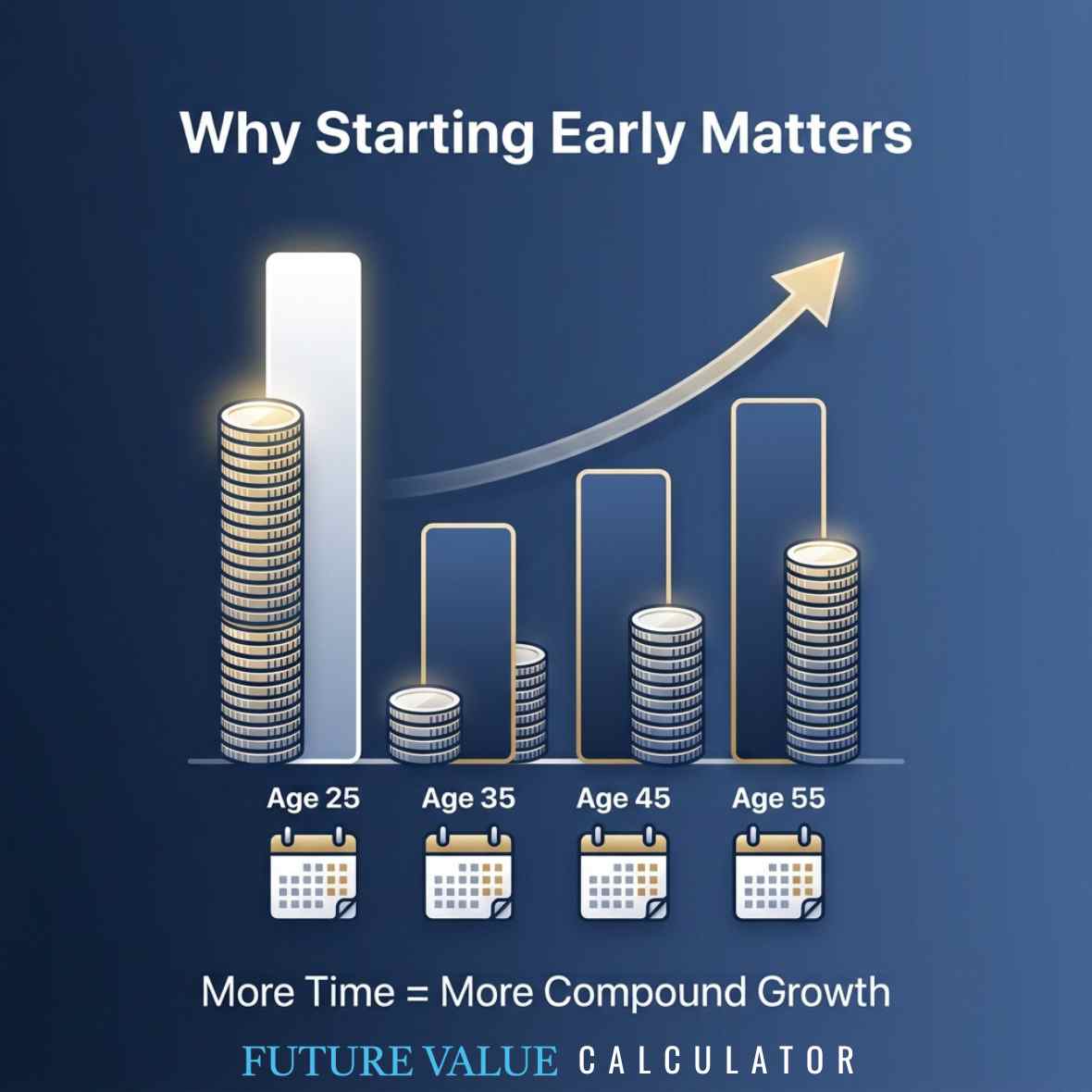
An investor saving $500/month from age 25 at 7% reaches $1.3 million by 65. Starting at 35 with identical contributions produces only $606,000 – less than half – despite contributing for only 10 fewer years. Time lost to compounding cannot be recovered.
Why Starting Early Is the Most Powerful Financial Decision
The single most important variable in any future value calculation is time. Here is the same $300/month contribution at 7%, started at different ages, all targeting retirement at 65:
|
Start Age |
Years Investing |
Total Contributed |
Future Value at 65 |
|---|---|---|---|
|
22 |
43 years |
$154,800 |
$982,839 |
|
30 |
35 years |
$126,000 |
$540,316 |
|
40 |
25 years |
$90,000 |
$243,022 |
|
50 |
15 years |
$54,000 |
$95,089 |
The person starting at 22 ends up with more than 10 times the balance of the person starting at 50 – despite contributing less than 3 times as much. The gap is not explained by contributions. It is explained entirely by compounding time.
This is not motivational advice. It is mathematics. And the future value calculator makes it visible and real – which is often exactly the push people need to start today.
EDITORIAL INTEGRITY
Meet the Authors
Two finance professionals independently review every formula, calculation, and piece of educational content on this site before publication.

Anfal
Financial Formula Reviewer & Academic Auditor
Masters in Accounting & Finance
An Accounting & Finance graduate currently pursuing an advanced Master’s degree at Teesside University (UK), Anfal leads our rigorous quality assurance pipeline. She systematically audits the algorithmic calculations behind our tools, cross-checking every output against institutional benchmarks and academic financial literature to eliminate calculation drift.

Sana Latif
Lead Developer & Technical Architect
Master of Business Administration | Finance Specialization
Sana handles the platform’s core infrastructure, technical SEO, and responsive site architecture. She is responsible for ensuring that all mathematical backend scripts execute flawlessly on the client side, maintaining absolute data privacy, rapid load speeds, and strict compliance with global web accessibility standards.
UNIVERSITY FINANCE STUDENT REVIEWS
Tested by Real Finance Students
Reviews from students across universities in the USA, UK, Pakistan, and Canada · Collected Jan–Jun 2026
PEER-REVIEWED SOURCES
FV Calc References & Academic Sources
Every formula used in this calculator is derived from or fully consistent with the following authoritative sources.
1- Brealey, R. A., Myers, S. C., & Allen, F. (2020). Principles of Corporate Finance (13th ed.). McGraw-Hill Education. Chapter 2. https://books.google.com/books/about/Principles_of_Corporate_Finance.html?id=nsrHuwEACAAJ&redir_esc=y
2- Ross, S. A., Westerfield, R. W., & Jordan, B. D. (2022). Fundamentals of Corporate Finance (13th ed.). McGraw-Hill Education. Chapter 6. https://www.mheducation.com/highered/product/fundamentals-of-corporate-finance-ross.html?pd=search&viewOption=student
3- Fabozzi, F. J., & Peterson Drake, P. (2009). Finance: Capital Markets, Financial Management, and Investment Management. Wiley. ISBN: 978-0-470-40735-4. https://onlinelibrary.wiley.com/doi/book/10.1002/9781118266984?utm_source=chatgpt.com
4- Bodie, Z., Kane, A., & Marcus, A. J. (2021). Investments (12th ed.). McGraw-Hill Education. Chapter 5, pp. 134–139. https://search.worldcat.org/title/Investments/oclc/1114274719
5- Dahlquist, J., & Knight, R. (2026). Principles of finance 2e. OpenStax. https://openstax.org/details/books/principles-finance-2e
6- Financial Industry Regulatory Authority. (2024, December 4). Calculating your investment returns. https://www.finra.org/investors/insights/investment-returns
7- U.S. Securities and Exchange Commission. (n.d.-a). Real return. Investor.gov. https://www.investor.gov/introduction-investing/investing-basics/glossary/real-return
COMMON QUESTIONS
Frequently Asked Questions
Try the Free Future Value Calculator Now
You now have everything you need to understand, calculate, and apply future value to your own financial situation. Use our free Future Value Calculator above to model your exact scenario – adjust your lump sum, monthly contributions, rate of return, time horizon, and inflation rate to see real-time projections.
Whether you need a quick FV calculator estimate, a detailed TVM calculator analysis, or a full investment future value calculator with inflation adjustment and year-by-year breakdown – it is all here, free, with no sign-up required.
The best time to start was yesterday. The second best time is right now.