
How Does Compounding Frequency Impact Future Value?
How does compounding frequency impact future value? Learn why more frequent compounding can increase growth, how the formula works, and what to compare.
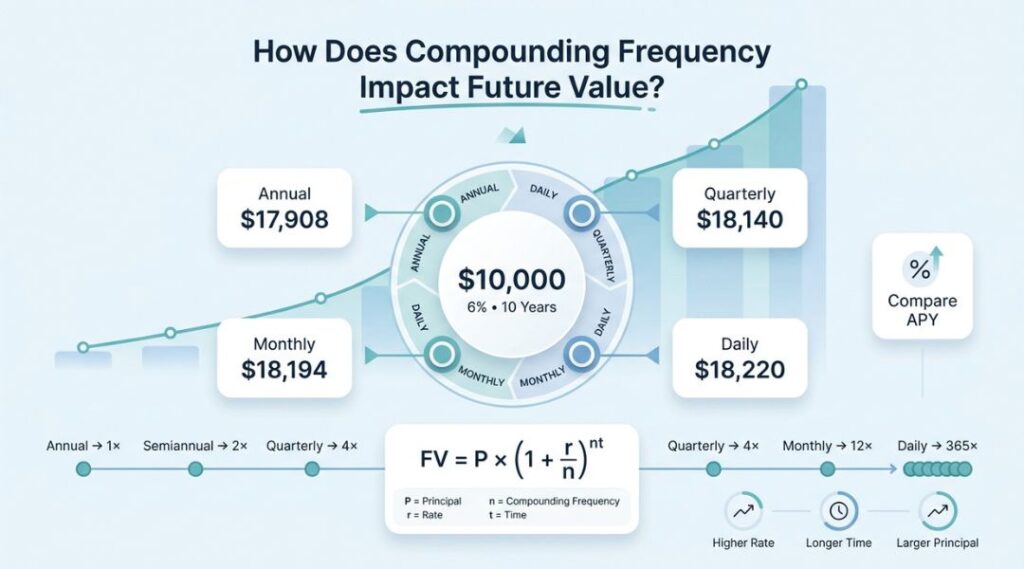
Two investments that begin at the same amount, interest rate, and time period can have slightly different ending amounts. This could be because the compounding occurs twice.
So, how does compounding frequency impact future value? If all the factors remain the same except that the interest rate is compounded more frequently, then the future value will be larger.
Here is the explanation as to why this happens, and when the distinction does indeed make a difference.
What Is Compounding Frequency?
Compounding frequency describes how often earned interest is added to the balance.
Common schedules include:
- Annually – once per year
- Semiannually – twice per year
- Quarterly – four times per year
- Monthly – 12 times per year
- Daily – typically 365 times per year
Once interest is added, future interest can be earned on both the original principal and previously accumulated interest. That is the basic mechanism behind compound growth.
How Compounding Frequency Changes Future Value
The standard compound-interest future value formula is:
FV = P × (1 + r/n)^(nt)
Where:
- P = starting principal
- r = annual interest rate
- n = number of compounding periods per year
- t = number of years
The variable n is what changes when compounding frequency changes. OpenStax notes that account value increases as compounding becomes more frequent when the other inputs remain constant.
You can use a future value calculator to compare how different rates, time periods, and compounding schedules affect the projected balance.
A Simple Comparison
Suppose $10,000 earns 6% annually for 10 years with no additional contributions.
Approximate future values are:
- Annual compounding: $17,908
- Quarterly compounding: $18,140
- Monthly compounding: $18,194
- Daily compounding: $18,220
More frequent compounding produces a higher balance because interest begins earning additional interest sooner. For a closer comparison, see how daily and monthly compounding can produce slightly different results.
Does More Frequent Compounding Always Make a Big Difference?
Not necessarily.
The benefit becomes larger when:
- The interest rate is higher
- The money remains invested longer
- The starting balance is larger
There are also diminishing gains. Moving from annual to monthly compounding may noticeably increase future value, but moving from monthly to daily compounding usually produces a much smaller improvement.
The effect of compounding becomes even more significant when regular monthly contributions grow over time.
Compare APY, Not Just the Stated Rate
When comparing savings products, compounding frequency should not be viewed in isolation.
The CFPB defines annual percentage yield, or APY, as a rate that reflects both the interest rate and the frequency of compounding. That makes APY especially useful when comparing accounts with different compounding schedules.
The Bottom Line
So, how does compounding frequency impact future value? The higher the frequency of compounding, the higher the future value due to the ability to get started compounding earlier and allowing interest to compound more times.
But frequency is just one component to consider in the calculation. The final result can be greatly influenced by interest, time, principal, contribution, and fees.

An Accounting & Finance graduate currently pursuing an advanced Master’s in accounting and finance degree at Teesside University (UK), Anfal leads our rigorous quality assurance pipeline. She systematically audits the algorithmic calculations behind our tools, cross-checking every output against institutional benchmarks and academic financial literature to eliminate calculation drift.