
How Much Should I Save Monthly for My Child’s College Fund in 18 Years?
How much should I save monthly for my child’s college fund in 18 years? Learn how to set a realistic target, factor in investment growth, and calculate it.
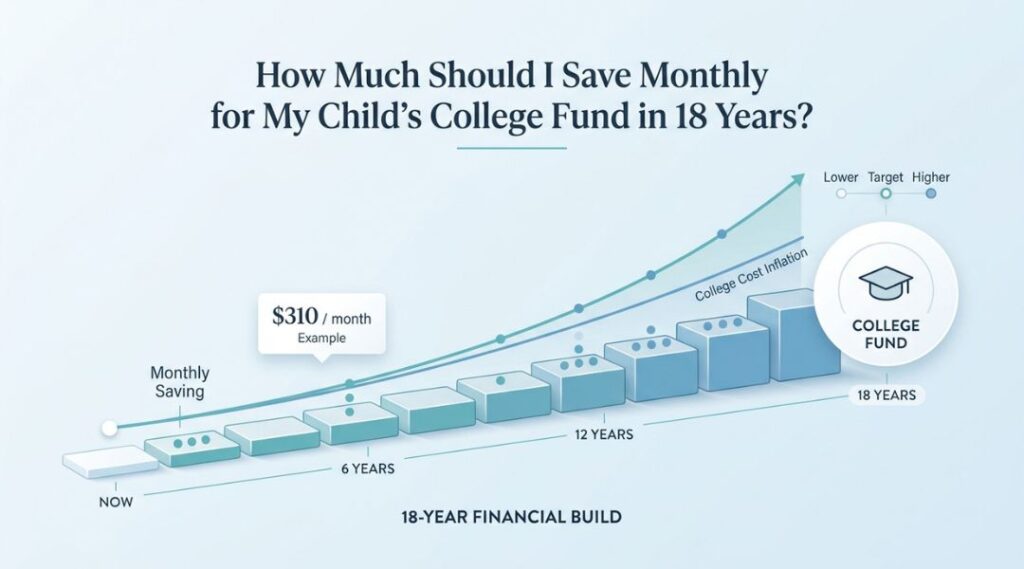
How Much Should I Save Monthly for My Child’s College Fund in 18 Years? If your child has 18 years before college, starting now gives your money valuable time to compound. However, no standard sum of savings will suit the purse of all families.
This number will vary based on the total investment required, the amount of savings you have, the projected growth of your investments, and the portion of the college fund you wish to finance out of your own savings.
Start With Your College Savings Target
Current college prices vary considerably. For 2025–26, average published tuition and fees are about $11,950 per year for an in-state public four-year college and $45,000 at a private nonprofit four-year college. Actual net costs can be lower after grants and other aid.
Instead of assuming you must fund 100% of college expenses, decide whether your goal is to cover:
- Tuition only
- A percentage of total costs
- A fixed dollar amount
- Tuition plus housing and other expenses
This makes your monthly target much more realistic.
How to Calculate Monthly College Savings
If you are starting with $0, a useful future-value formula for regular monthly deposits is:
Monthly contribution = FV × i ÷ ((1 + i)^n − 1)
Where:
- FV = your target college fund
- i = expected monthly investment return
- n = number of monthly contributions
Example: Saving $120,000 in 18 Years
Suppose your goal is $120,000, you have 18 years to save, and your account earns an average 6% annual return.
You would need to contribute approximately $310 per month, assuming monthly contributions and consistent returns. Comparing this with other monthly investment scenarios can help show how contribution amounts and time periods affect projected growth.
Without investment growth, reaching $120,000 would require about $556 per month. Compounding makes the difference, but investment returns are never guaranteed.
Don’t Forget College-Cost Inflation
One mistake that people typically make when they’re planning is picking a target that’s based on college expenses at this moment.
Major changes will occur in tuition, housing, fees, and other costs over the years. Consider calculating several targets rather than relying on one forecast. This is why it is important to understand how inflation affects future value when setting a long-term college savings target.
For instance, consider the case of a lower cost, a middle cost, and a higher cost scenario. This provides options in case college costs or your child’s vision changes.
Consider Where You Save
A 529 saving plan is an option created for education savings. In general, under current federal regulations, earnings are not considered income to the beneficiary, and withdrawals for qualified higher education expenses will not be subject to income tax.
Results can vary depending on your tax, investment decisions, and state benefits.
The Bottom Line
So, how much should I save monthly for my child’s college fund in 18 years? Begin with the investment goal you have in mind, then move backwards through time and with an appropriate growth rate for your investment.
Instead of striving for a perfect number, periodically check your projection and tweak contributions as your income, college costs, and savings evolve.

An Accounting & Finance graduate currently pursuing an advanced Master’s in accounting and finance degree at Teesside University (UK), Anfal leads our rigorous quality assurance pipeline. She systematically audits the algorithmic calculations behind our tools, cross-checking every output against institutional benchmarks and academic financial literature to eliminate calculation drift.