
Does Future Value Account for Inflation?
Does future value account for inflation? Not automatically. Learn how nominal and real future value differ, plus the formula for inflation-adjusted growth.
Does Future Value Account for Inflation? Future value calculations are used to calculate the amount of money that will accumulate over time, but it is crucial to note that a standard future value calculation doesn’t necessarily consider inflation.
This can lead to an increase in your future balance and a significant slowdown in your purchasing power. Knowing the difference between nominal and real future value can make long-term financial projections much more useful.
Does Future Value Include Inflation?
Not unless inflation is specifically built into the calculation.
The basic future value formula is:
FV = PV × (1 + r)^n
PV is your starting amount, r is the growth or interest rate, and n is the number of periods. Investor.gov defines future value as the value of an asset at a specified future date.
The result can also vary depending on how often interest is added. Compounding frequency affects how frequently earned interest is added to the balance.
Inflation is a separate factor. The Federal Reserve defines inflation as a general increase in the prices of goods and services over time. As prices rise, the purchasing power of each dollar generally falls.
Nominal Future Value vs. Real Future Value
Nominal Future Value
Nominal future value is the projected dollar balance before adjusting for inflation.
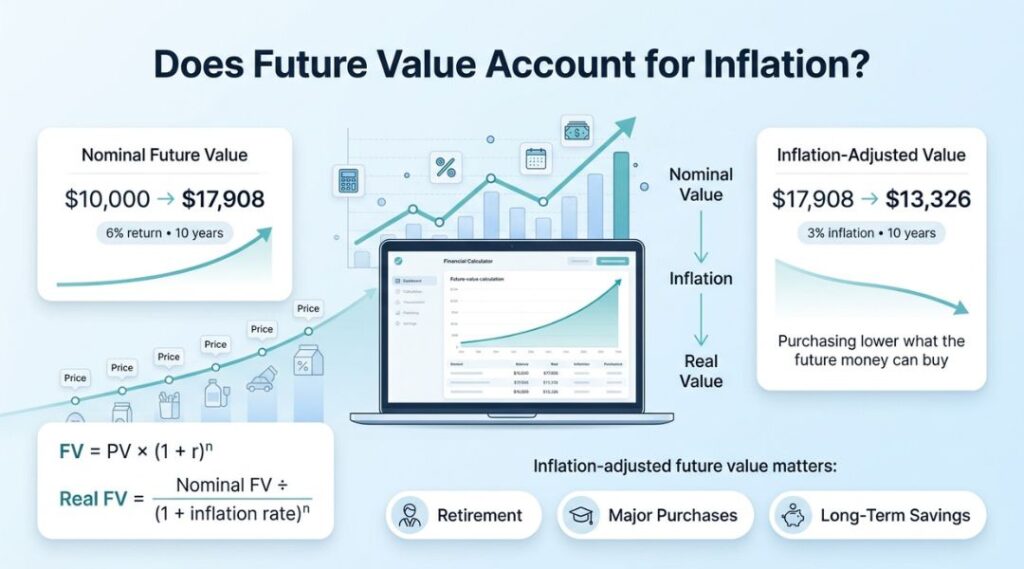
For example, $10,000 growing at 6% annually for 10 years becomes approximately $17,908.
Inflation-Adjusted Future Value
To express that future balance in today’s purchasing power, you can adjust it for inflation:
Real FV = Nominal FV ÷ (1 + inflation rate)^n
If inflation averages 3% over those same 10 years, the $17,908 balance would have purchasing power of roughly $13,326 in today’s dollars.
This distinction matters because nominal rates are not inflation-adjusted, while real rates account for inflation.
Avoid Double-Counting Inflation
If the return you enter into a future value calculation is already a real, inflation-adjusted rate, don’t subtract or adjust for inflation again. Doing so would count inflation twice and understate the result.
When Should You Account for Inflation?
Inflation-adjusted future value is particularly useful when planning for:
- Early Retirement
- Education costs
- Major future purchases
- Long-term savings goals
For short-term estimates, nominal future value may be enough. For goals decades away, comparing nominal and real values provides a much clearer picture.
The Bottom Line
So, does future value account for inflation? No, not by default. A regular future value calculation will tell you how many dollars you will have, and not what those dollars are worth.

An Accounting & Finance graduate currently pursuing an advanced Master’s in accounting and finance degree at Teesside University (UK), Anfal leads our rigorous quality assurance pipeline. She systematically audits the algorithmic calculations behind our tools, cross-checking every output against institutional benchmarks and academic financial literature to eliminate calculation drift.