
What Is the Future Value of Rental Income vs. Index Funds?
What is the future value of rental income vs. index funds? Compare cash flow, appreciation, compounding, costs, taxes, and risk over the long term.
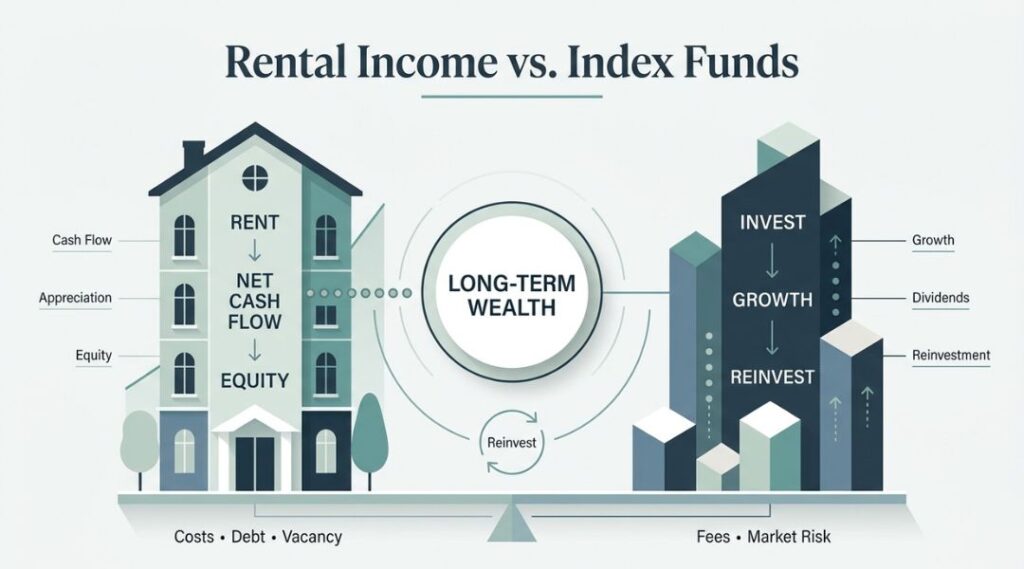
What Is the Future Value of Rental Income vs. Index Funds? Rental property and index funds may both serve as vehicles for wealth creation, but comparing future values isn’t done quite the same way as comparing rents with returns, even in the stock market.
The value of an index fund generally consists of investment growth, plus reinvested distributions. Rental real estate may produce value by way of net rental earnings, appreciation of the property, and repayment of the mortgage principal.
A better comparison is on anything that contributes to or subtracts from your ultimate net worth.
How to Calculate an Index Fund’s Future Value
For a lump-sum investment, a basic projection is:
FV = PV × (1 + r)^n
Where PV is your initial investment, r is the assumed annual return, and n is the number of years.
If dividends and other distributions are reinvested, they contribute to compounding. The compounding frequency and reinvestment assumptions can also affect how a future value projection is calculated.
Fees matter as well: Investor.gov notes that fund expenses reduce investment returns over time.
An index fund also carries market risk, so an assumed return should be treated as a projection—not a guarantee.
How Is Rental Property Future Value Different?
Rental property requires a broader calculation. You can also estimate future property value separately by applying an assumed appreciation rate over your investment period.
A useful framework is:
Future rental wealth = Future property value − remaining debt + accumulated net rental cash flow
Start With Net Rent, Not Gross Rent
If a property collects $2,000 per month in rent, that does not mean the owner earns $24,000 annually.
Rental expenses may include:
- Mortgage interest
- Property taxes
- Insurance
- Maintenance and repairs
- Property management
- Utilities paid by the owner
- Vacancy-related costs
The IRS confirms that rental income is generally taxable and that qualifying rental expenses, including maintenance, insurance, taxes and depreciation, may be deductible under applicable rules.
Reinvestment Makes a Major Difference
Here is an often-overlooked point: rental income only compounds if you reinvest it.
If you spend the monthly cash flow, it provides income but does not create additional future value through compounding. If you reinvest that cash flow, however, it can generate its own returns, making the comparison with a dividend-reinvesting index fund more meaningful.
Regular contributions can have a similar compounding effect over time, as shown by how monthly investing grows over different time periods.
Rental Property vs. Index Funds: What Should You Compare?
For a useful long-term projection, compare:
- Initial cash invested
- Net annual cash flow
- Expected appreciation or investment return
- Reinvestment assumptions
- Financing and remaining mortgage balance
- Fees and operating expenses
- Taxes
- Investment timeframe
- Liquidity and risk
For investments with different cash-flow patterns, it can also be useful to distinguish between future value and IRR, since they answer different investment questions.
Index funds may provide diversification and relatively simple management, while a rental property concentrates more capital in a specific asset and location. Index funds themselves still carry investment risk and may not perfectly track their underlying indexes.
The Bottom Line
So, what is the future value of rental income vs. index funds? The winner is not universal. The outcome is based on assumptions that were made with the investment.
If the stock is an index fund, then compute compound total returns after fees. Consider appreciation, equity, net rental cash flow, reinvestment, and ownership expenses for rental property.
You should also consider how inflation affects future value, particularly when comparing long-term investment outcomes.
If comparing scenarios, use the Future Value Calculator to keep the investment amount and duration consistent where possible. An apples-to-apples comparison is more useful than comparing the headline value of a rental property with the projected value of an index fund.

An Accounting & Finance graduate currently pursuing an advanced Master’s in accounting and finance degree at Teesside University (UK), Anfal leads our rigorous quality assurance pipeline. She systematically audits the algorithmic calculations behind our tools, cross-checking every output against institutional benchmarks and academic financial literature to eliminate calculation drift.