
How Do You Calculate the Future Value of Real Estate Property?
How do you calculate the future value of real estate property? Learn the formula, appreciation assumptions, costs, and factors that shape future home value.
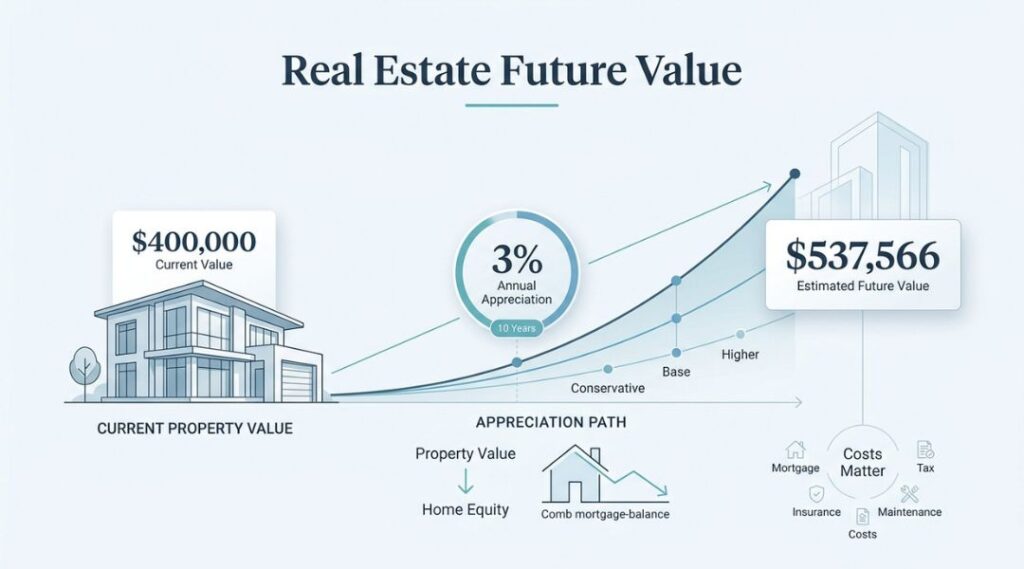
While real estate may be valued up over time, making a guess at a real estate value in the future is not enough.
So, how do you calculate the future value of real estate property? The easiest way is to add up the current property value with a rate of assumed annual increase. But location, improvements, ownership costs, and the uncertainty of appreciation should be taken into account for a more realistic figure.
Future Value Formula for Real Estate
A basic property-value projection uses:
FV = PV × (1 + g)^n
Where:
- FV = estimated future property value
- PV = current property value
- g = assumed annual appreciation rate
- n = number of years
The calculation works by projecting today’s property value forward, which is the opposite perspective of present value and future value calculations.
Example: $400,000 Property Growing at 3%
Suppose a home is worth $400,000 today and you assume it appreciates by 3% annually for 10 years.
FV = $400,000 × (1.03)^10
The estimated future value would be approximately $537,566.
This projection also depends on how the compounding frequency is handled when calculating growth over time.
That does not mean the property will sell for exactly that amount. The 3% rate is an assumption, not a guaranteed return.
How Do You Choose an Appreciation Rate?
Avoid automatically applying a national average to every property.
Real estate performance can differ significantly by location and period. FHFA’s House Price Index tracks historical changes in single-family home prices at national, state, metropolitan, county, ZIP-code, and other geographic levels.
For a more useful projection:
- Review long-term price trends in the property’s local market
- Test conservative, moderate, and higher appreciation rates
- Avoid assuming unusually strong recent growth will continue indefinitely
- Recalculate periodically as market conditions change
Long-term projections should also consider how inflation affects future value, since a property’s future dollar value may not represent the same purchasing power as today’s dollars.
Future Property Value Is Not the Same as Investment Profit
This distinction is easy to miss.
A home increasing from $400,000 to $537,566 does not necessarily mean you earned $137,566 in profit.
Your actual financial result may also involve:
- Mortgage interest
- Property taxes
- Homeowners insurance
- Maintenance and repairs
- Renovation costs
- Buying and selling expenses
- Rental income, if applicable
The difference becomes even more important when evaluating rental property as an investment, because rental income, appreciation, debt, and operating costs can all affect the final outcome.
The CFPB notes that homeowners may face ongoing costs including property taxes, insurance, HOA fees, maintenance, and repairs.
Don’t Confuse Property Value With Equity
Future market value and future home equity are also different.
Home equity = Property value − Remaining mortgage balance
Your property could appreciate while your equity grows even faster because you are simultaneously paying down your loan.
The Bottom Line
So, how do you calculate the future value of real estate property? Multiply its potential value by an assumed appreciation rate that is compounded over the number of years that you think you will own it.
The formula is simplicity itself, and the selection of realistic assumptions is the difficult and more crucial part.
When using Future Value Calculator, think about generating multiple appreciation scenarios rather than just one. Next, think of projected property value, actual property value, and projected investment return as three separate numbers. Once you understand the difference, you will see the real value of your property far better than you would otherwise.

An Accounting & Finance graduate currently pursuing an advanced Master’s in accounting and finance degree at Teesside University (UK), Anfal leads our rigorous quality assurance pipeline. She systematically audits the algorithmic calculations behind our tools, cross-checking every output against institutional benchmarks and academic financial literature to eliminate calculation drift.