
How Do You Calculate Future Value for Early Retirement?
How do you calculate future value for early retirement? Learn the formula, inflation adjustment, contribution timing, and key risks that shape your target.
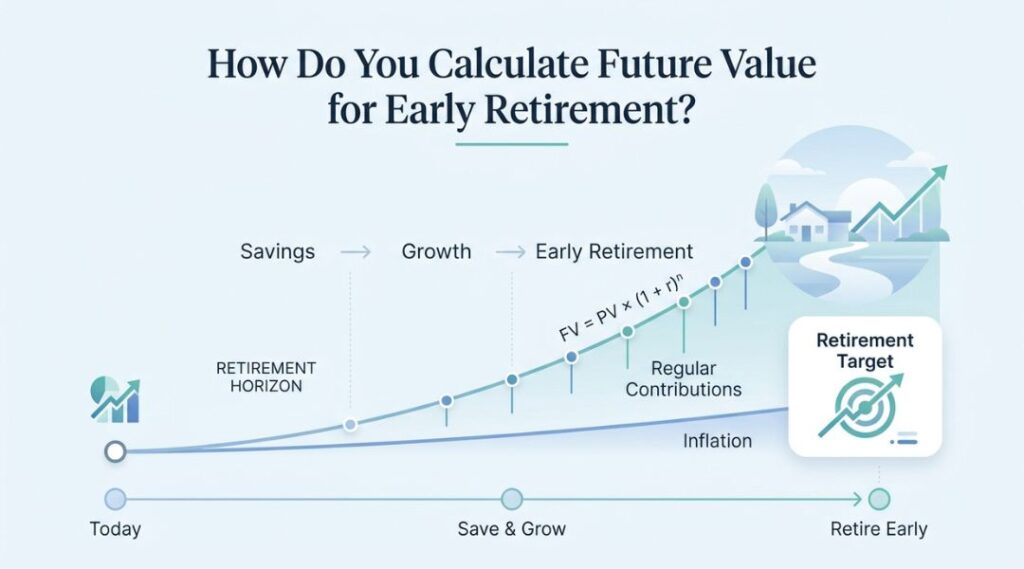
When you think about early retirement, it’s particularly important to use future value calculations, as you will need to consider two timelines: the length of time for which your money must grow, and afterwards, how long it might be required to support you.
So, how do you calculate future value for early retirement? The first step is to calculate how much you have saved so far and make plans on how much more you will save until you retire, and then check whether there’s enough money saved to cover your expected expenses.
Calculate the Future Value of Your Current Savings
For money already invested, the basic formula is:
FV = PV × (1 + r)^n
Where:
- PV = current portfolio value
- r = expected return per period
- n = number of periods until retirement
For monthly or other frequent compounding, adjust the interest rate and number of periods accordingly.
Add the Future Value of Ongoing Contributions
Most retirement plans involve regular contributions, so calculating only your existing balance can significantly understate the result.
For equal contributions made at the end of each period:
FV = PMT × [((1 + r)^n − 1) ÷ r]
Here, PMT represents each contribution. The result can also vary depending on the compounding frequency used in the calculation.
OpenStax uses this future-value-of-an-annuity approach for projecting a series of regular investments.
Your total projected retirement balance is generally the future value of your existing savings plus the future value of future contributions. Also see how monthly contributions can grow over 10, 20, and 30 years.
Adjust for Inflation
A projected balance of $1 million decades from now will not buy what $1 million buys today.
When planning for retirement, it is best to get an idea of costs in today’s dollars and then factor in any inflation. Other factors that can influence the longevity of retirement savings include inflation, health care expenses, market fluctuations, and life expectancy.
This is why both nominal future value and inflation-adjusted purchasing power matter.
Understanding how inflation affects future value can help you estimate your portfolio’s actual purchasing power.
Don’t Stop at the Ending Balance
Estimate How Much You Actually Need
A future value calculation tells you what your portfolio might grow to. It does not tell you whether that amount is sufficient.
Consider:
- Expected annual retirement spending
- Taxes and investment fees
- Health insurance and medical costs
- Other income sources
- The number of retirement years you may need to fund
- Market downturns early in retirement
Sequence-of-returns risk is especially relevant because withdrawals during an early market decline can reduce the assets available for a later recovery.
Plan for Access Before Age 59½
Early retirees should also consider where their savings are held. Certain retirement-account distributions before age 59½ may face an additional 10% federal tax unless an exception applies.
A large future value is therefore not the same as having the right amount of accessible, after-tax money at every stage of retirement.
The Bottom Line
So, how do you calculate future value for early retirement? Calculate current savings, include future savings, factor in compounding and the effects of inflation, and compare with honest expectations of retirement spending.

An Accounting & Finance graduate currently pursuing an advanced Master’s in accounting and finance degree at Teesside University (UK), Anfal leads our rigorous quality assurance pipeline. She systematically audits the algorithmic calculations behind our tools, cross-checking every output against institutional benchmarks and academic financial literature to eliminate calculation drift.