
What Is the Future Value of a 529 Plan With a 7% Average Return?
What is the future value of a 529 plan with 7% average return? See realistic 18-year examples, formulas, fees, taxes, and why 7% is only an estimate.
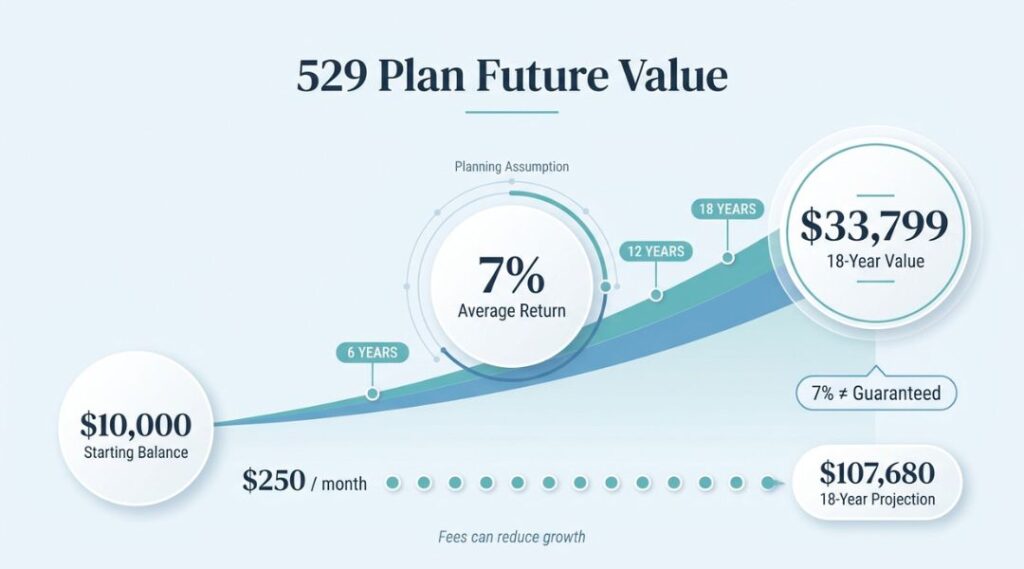
Generating a 7% average return can result in significant growth for a 529 college savings plan, particularly when the investment period is long. However, there isn’t a single value of future value, given that you don’t know your starting account balance, the time by which you invest, and your contributions. So, What Is the Future Value of a 529 Plan With a 7% Average Return?
There are two ways to estimate what you should expect to get: calculating the return on money you already invested, and also the money that you continuously add to the investment.
The guide includes information on how to estimate the future value of a 529 Plan.
How to Calculate a 529 Plan’s Future Value
For a lump-sum investment, the basic formula is:
FV = PV × (1 + r)^n
Where:
- FV = future value
- PV = starting balance
- r = annual return
- n = number of years
Example: $10,000 Invested for 18 Years
If you invest $10,000 and it earns an average 7% annually for 18 years:
$10,000 × (1.07)^18 = about $33,799
Your original $10,000 would therefore grow by roughly $23,799, assuming no withdrawals, fees, taxes, or changes in return.
What If You Contribute Every Month?
Regular contributions can have an even larger effect.
For example, contributing $250 per month for 18 years at an assumed 7% annual return, compounded monthly, would produce approximately $107,680.
You would contribute $54,000 yourself, with the remaining projected balance coming from investment growth.
Starting earlier matters because your earliest contributions have the most time to compound.
A similar example of monthly investing over different time periods shows how the combination of contributions and compounding can change the projected balance.
Is a 7% Return Guaranteed?
No. A 7% return is a planning assumption, not a promised result. When using future-value projections, understanding the limitations of future value calculations can help you avoid treating an estimated balance as a guaranteed outcome.
529 education savings plans typically invest in portfolios that may include stocks, bonds, mutual funds, or similar investments. Returns can fluctuate, and fees can reduce your actual growth. Investor.gov recommends reviewing both investment risk and plan expenses when evaluating a 529 plan.
For more realistic planning, consider testing several assumptions, such as:
- 4% for a conservative scenario
- 7% for a moderate growth estimate
- 9% for a higher-growth scenario
This produces a range rather than relying on one precise forecast.
Don’t Overlook the 529 Tax Advantage
Under current federal rules, earnings inside a 529 plan generally accumulate tax-free, and distributions used for qualified education expenses are generally not taxable.
That tax treatment can help more of your investment growth remain available for education, although individual state tax rules and benefits vary.
The Bottom Line
So, what is the future value of a 529 plan with 7% average return? It is mainly influenced by the amount you invest, the frequency of investment, and the duration of investment.
A $10,000 lump sum payment would be worth approximately $33,799 in 18 years, and $250 per month payments would be worth about $107,680 in 18 years if invested at the rates and returns listed above.
You can test different contribution amounts, return assumptions, and time periods with the Future Value Calculators to see how changes affect your projected college savings.

An Accounting & Finance graduate currently pursuing an advanced Master’s in accounting and finance degree at Teesside University (UK), Anfal leads our rigorous quality assurance pipeline. She systematically audits the algorithmic calculations behind our tools, cross-checking every output against institutional benchmarks and academic financial literature to eliminate calculation drift.