
What Are the Main Limitations of Using Future Value Calculations?
What are the main limitations of using future value calculations? Learn where projections can mislead and how to build more realistic financial estimates.
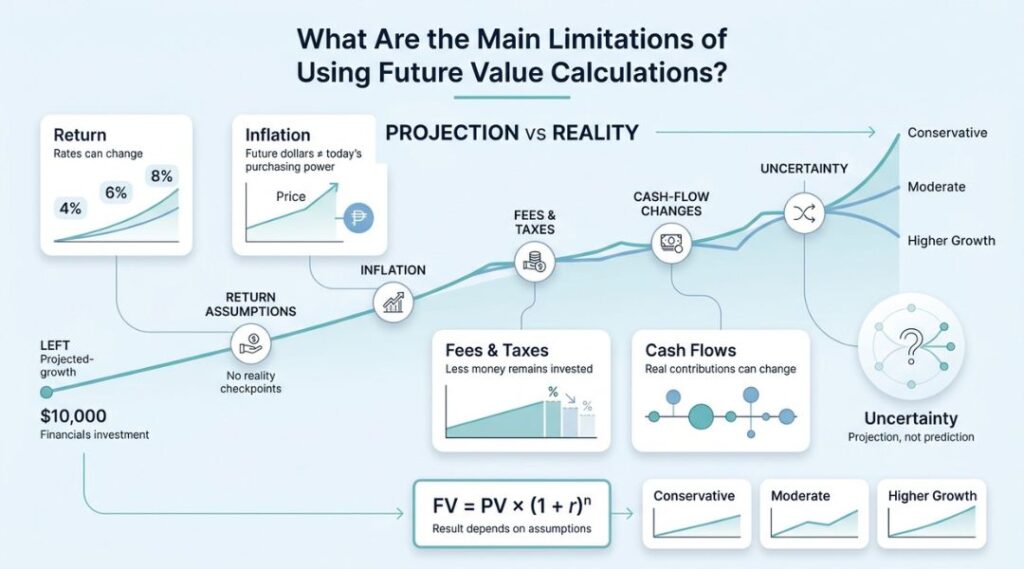
Future value calculations are helpful to estimate the future value of money. However, it is not a prediction. But What Are the Main Limitations of Using Future Value Calculations?
It is possible to have a formula for a future value which may give an exact answer depending on the assumptions you plug into it; but in reality, financial outcomes do not always unfold in a perfectly predictable manner. Knowing what those restrictions are can help you to use future value as a planning tool instead of taking the outcome for granted.
1. Future Value Depends Heavily on the Assumed Return
A basic future value calculation commonly assumes that the same rate of return continues throughout the entire period.
That works well for illustrating compound growth, but many investments do not earn a fixed return every year. Investor.gov notes that investments involve risk and market fluctuations, rather than a guaranteed rate of return.
Even a small change in the assumed return can create a large difference over several decades.
A Better Approach
Instead of calculating only one outcome, compare several scenarios, for example, conservative, moderate, and higher-growth assumptions.
2. Inflation May Not Be Included
A future balance expressed in dollars does not necessarily tell you how much those dollars will buy.
Unless inflation is specifically incorporated, the calculation usually shows nominal future value rather than purchasing power. Investor.gov distinguishes nominal returns from real returns, which account for inflation and taxes.
For long-term goals, looking at both nominal and inflation-adjusted future value provides a more useful picture.
3. Fees and Taxes Can Reduce the Result
Future value projections may also overstate growth if they use a gross return without deducting investment fees, account expenses, or applicable taxes.
The SEC warns that even relatively small recurring fees can materially reduce an investment portfolio over time because less money remains invested and compounding.
Whenever possible, use an estimated net return rather than an idealized headline rate.
4. Real Cash Flows Are Often Messier
Simple calculations may assume that:
- Contributions remain constant
- Deposits happen at regular intervals
- Money stays invested continuously
- Interest is reinvested
- No unexpected withdrawals occur
Real saving patterns rarely remain that consistent.
Contribution timing matters too. Money invested earlier has more time to compound than money contributed later. Compounding frequency can also affect the projected result when other assumptions remain the same.
5. A Precise Result Can Create False Confidence
Perhaps the biggest limitation is psychological. A calculator might produce $527,438.16, but that level of precision does not mean the future outcome is equally certain.
Future value is better viewed as a scenario based on assumptions, not a forecast of exactly what will happen.
The Bottom Line
So, what are the main limitations of using future value calculations? They rely on expectations for returns, inflation, fees, taxes, timing, and actions that can change.
Try out several viable possibilities rather than a single number prediction.

An Accounting & Finance graduate currently pursuing an advanced Master’s in accounting and finance degree at Teesside University (UK), Anfal leads our rigorous quality assurance pipeline. She systematically audits the algorithmic calculations behind our tools, cross-checking every output against institutional benchmarks and academic financial literature to eliminate calculation drift.