
Is Future Value a Guarantee of Return?
Is future value a guarantee of return? Learn why future value is a projection, which assumptions affect it, and when returns may be more predictable overall.
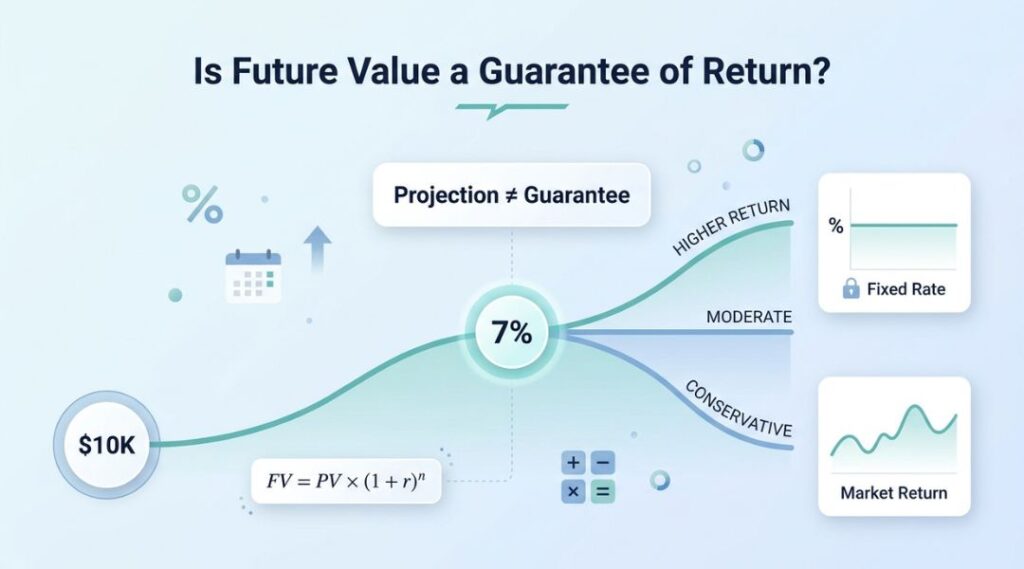
Is Future Value a Guarantee of Return? A future value calculator can generate an extremely accurate number. That accuracy can lead to a feeling of certainty, but future value does not necessarily translate into return of capital.
Future value simply estimates what money could be worth at a specified future date based on inputs such as the starting balance, interest or growth rate, compounding frequency, and time period.
The important question is whether those inputs are guaranteed or merely assumptions.
Why Future Value Is Usually a Projection
A common future value formula is:
FV = PV × (1 + r)^n
The calculation itself is mathematically exact. The uncertainty comes from the value you enter for r, the rate of return.
If you assume an investment will earn 7% every year, the calculator can show exactly what that assumption produces. It cannot guarantee that the investment will actually earn 7%.
For investments exposed to market risk, returns can rise, fall, or even become negative. Investor.gov notes that guaranteeing returns on market-risk investments is virtually impossible because future performance depends partly on market forces.
When Can Future Value Be More Predictable?
Fixed Returns Are Different
Some financial products may offer a stated or contractually fixed interest rate. In that situation, future value can be more predictable if:
- The rate remains fixed
- The money stays invested for the full term
- Interest compounds as expected
- No early withdrawals or penalties apply
- The issuer meets its obligations
Even then, the future value formula does not create the guarantee. Any guarantee comes from the terms and protections of the financial product itself.
What Can Make Actual Returns Different?
For market-based investments, several factors can cause the final balance to differ from a future value estimate:
- Changing investment returns
- Market volatility
- Fees and expenses
- Taxes
- Withdrawals or missed contributions
- Changes in compounding assumptions can also affect the projected result, particularly when comparing different compounding frequencies
- Inflation reducing purchasing power
This is why a projected balance should be treated as a planning estimate rather than a promised outcome.
A Better Way to Use Future Value
Instead of relying on one assumed return, calculate several scenarios.
For example, compare results using conservative, moderate, and higher-return assumptions. You can also see how different return assumptions affect long-term monthly investment growth.
This gives you a range of possible outcomes and shows how sensitive your long-term result is to changes in the return rate.
It is generally more useful than planning around one seemingly precise number.
The Bottom Line
So, is future value a guarantee of return? No. Future value is a mathematical projection based on the assumptions you provide.
For fixed-rate products, the eventual balance may be relatively predictable when the contractual terms are known. For market investments, however, actual returns can differ substantially from projections. FINRA likewise cautions investors against treating guaranteed investment returns as realistic for investments that carry risk.

An Accounting & Finance graduate currently pursuing an advanced Master’s in accounting and finance degree at Teesside University (UK), Anfal leads our rigorous quality assurance pipeline. She systematically audits the algorithmic calculations behind our tools, cross-checking every output against institutional benchmarks and academic financial literature to eliminate calculation drift.