
Annuity Due vs. Ordinary Annuity: Formulas, Differences, and Examples
Annuity due vs. ordinary annuity explained with formulas and examples. Learn how payment timing changes present value, future value, and financial results.
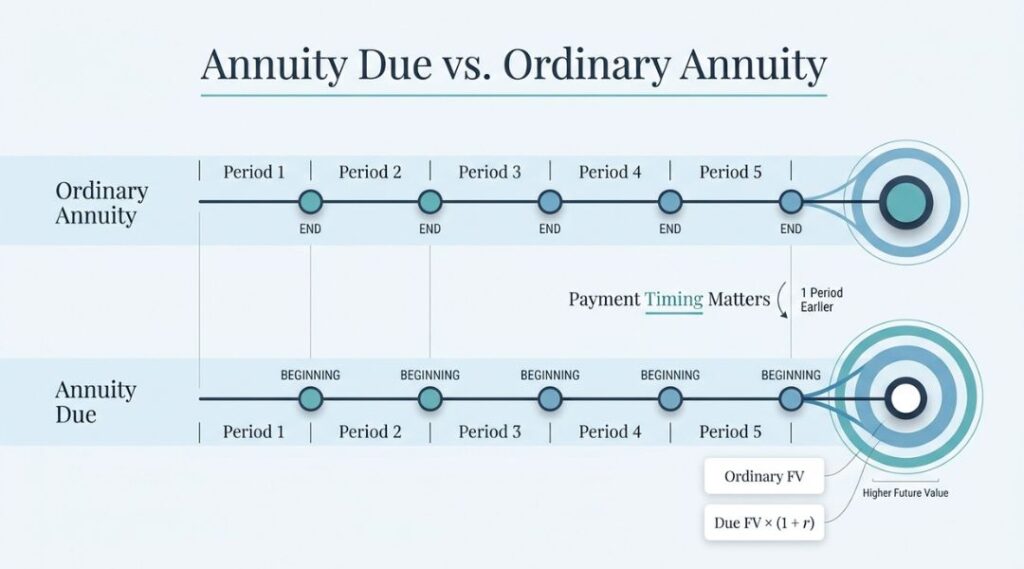
An annuity is a series of equal payments that occur regularly. However, this could make quite a difference if the timing of each payment changes.
The distinction between annuity due vs. ordinary annuity is simple: An ordinary annuity is an annuity whose payments are made at the end of each period, while an annuity due is an annuity whose payments are made at the beginning of each period. That one-period transformation is felt both in terms of the current value and the far future value.
What Is an Ordinary Annuity?
An ordinary annuity has payments at the end of each period.
If you contribute $500 monthly, for example, the first contribution is made at the end of the first month.
Its future value formula is:
FV = PMT × [((1 + r)^n − 1) ÷ r]
Where:
- PMT = payment per period
- r = interest rate per period
- n = number of payments
This formula is also used when calculating the future value of an annuity with regular payments over time.
What Is an Annuity Due?
An annuity due has payments at the beginning of each period.
Because every payment is invested or received one period earlier, each payment gets one additional period of growth.
The future value formula is:
FV Due = FV Ordinary × (1 + r)
The same adjustment applies to present value and future value, which are two sides of the same time-value-of-money concept.
PV Due = PV Ordinary × (1 + r)
Annuity Due vs. Ordinary Annuity Example
Suppose you invest $3,000 annually for five years at a 4% annual return.
With payments made at the end of each year:
Ordinary annuity FV ≈ $16,249
With payments made at the beginning:
Annuity due FV ≈ $16,899
The difference is roughly $650, even though the payment amount, interest rate, and number of contributions are identical.
Why? Every annuity-due contribution receives an extra year of compounding.
Which One Has a Higher Value?
When the payment, rate, and number of periods are the same:
- An annuity due has a higher future value
- An annuity due has a higher present value
- The difference becomes larger as the interest rate or payment amount increases
The payment timing, not the number of payments, is what creates the difference.
How to Identify the Correct Annuity Type
Ask one question: When does the payment happen?
If payments occur at the end of the period, use ordinary-annuity calculations. If they occur at the beginning, use annuity-due calculations.
Using the wrong timing assumption can produce an inaccurate projection, especially across long periods.
The Bottom Line
The main distinction in Annuity Due vs. Ordinary Annuity: Formulas, Differences, and Examples is the difference in timing.
The payment of ordinary annuities is made at the end of each period. Payments made as annuities due occur at the beginning, and each payment includes one additional compounding period.
Use our future value calculator to compare how different payment amounts, rates, and time periods affect your projected results.

An Accounting & Finance graduate currently pursuing an advanced Master’s in accounting and finance degree at Teesside University (UK), Anfal leads our rigorous quality assurance pipeline. She systematically audits the algorithmic calculations behind our tools, cross-checking every output against institutional benchmarks and academic financial literature to eliminate calculation drift.