
What Is the Difference Between Future Value and Internal Rate of Return (IRR)?
Future Value vs. IRR explained clearly. Learn how FV measures an ending dollar amount while IRR measures return, plus when to use each investment metric.
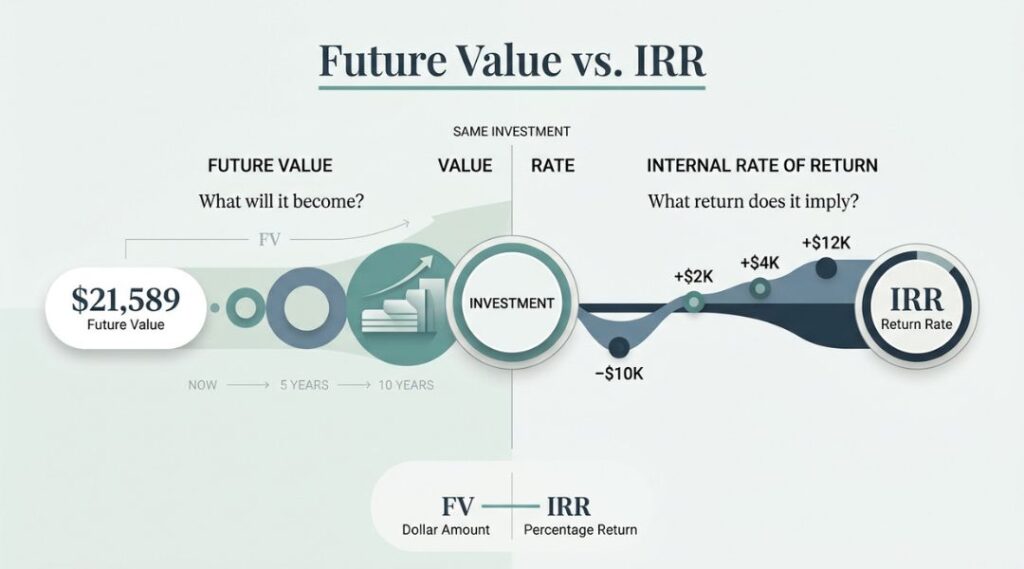
What Is the Difference Between Future Value and Internal Rate of Return (IRR)? Both Future Value (FV) and Internal Rate of Return (IRR) deal with the time value of money, but raise entirely different questions.
Future Value lets you know what the value of your money might be in the future. IRR gives you the internal rate of return for a series of cash flows.
What Is Future Value?
Future Value estimates what an amount of money today could grow to after earning a specified return for a certain period.
A basic formula is:
FV = PV × (1 + r)^n
Where:
- PV = present value
- r = assumed rate of return
- n = number of periods
For example, $10,000 growing at 8% annually for 10 years would have a future value of approximately $21,589.
You can calculate future value using Excel, or future value calculator when working with different assumptions or larger sets of financial data.
The important point is that you provide the return assumption. The calculation then determines the future dollar value.
OpenStax describes FV as the value money can reach over time as returns accumulate.
What Is Internal Rate of Return?
IRR works in the opposite direction.
Instead of entering a return and calculating a value, you enter the investment’s cash inflows and outflows and solve for the rate of return.
Technically, IRR is the discount rate that makes:
NPV = 0
In other words, the present value of expected inflows equals the present value of outflows at the IRR.
FV vs. IRR at a Glance
The easiest distinction is:
- Future Value output: a dollar amount
- IRR output: a percentage
- FV asks: “What will this money become at my assumed return?”
- IRR asks: “What return do these cash flows imply?”
When Should You Use Each?
Use Future Value when estimating:
- Retirement or college savings growth
- The future balance of an investment
- Compound growth over a known timeframe
Use IRR when evaluating:
- Investments with multiple cash flows
- Business or capital projects
- Opportunities requiring an upfront investment followed by future payments
IRR is often compared with a required rate of return or cost of capital.
When the investment involves regular payments rather than a single initial amount, a future value of an annuity calculation may be more appropriate.
One Important Limitation of IRR
A higher IRR does not automatically mean a better investment.
IRR can be misleading when comparing projects of very different sizes, and unusual cash-flow patterns can sometimes produce more than one IRR.
Future Value has its own limitation: its result is only as realistic as the return assumption you enter.
This is why understanding the limitations of future value calculations is important when using projections for financial planning.
The Bottom Line
So, what is the difference between Future Value and Internal Rate of Return (IRR)? Future Value determines the outcome amount given a set of returns; IRR determines the return that is implied in an investment’s cash flows.
If you think about it: FV solves for value, and IRR solves for rate.
FutureValue will be very helpful when you have your own growth-rate assumption, and you want to know how your money might fare. When the investment involves multiple cash flows, the IRR information can be important and should be used in combination with the size and timing of the cash flows, the risk of the cash flows, and the economics of the investment.

An Accounting & Finance graduate currently pursuing an advanced Master’s in accounting and finance degree at Teesside University (UK), Anfal leads our rigorous quality assurance pipeline. She systematically audits the algorithmic calculations behind our tools, cross-checking every output against institutional benchmarks and academic financial literature to eliminate calculation drift.