
Present Value (PV) Vs Future Value (FV)
Present Value (PV) vs Future Value (FV): understand the key differences, uses, and how time and interest connect today’s money with tomorrow’s value.
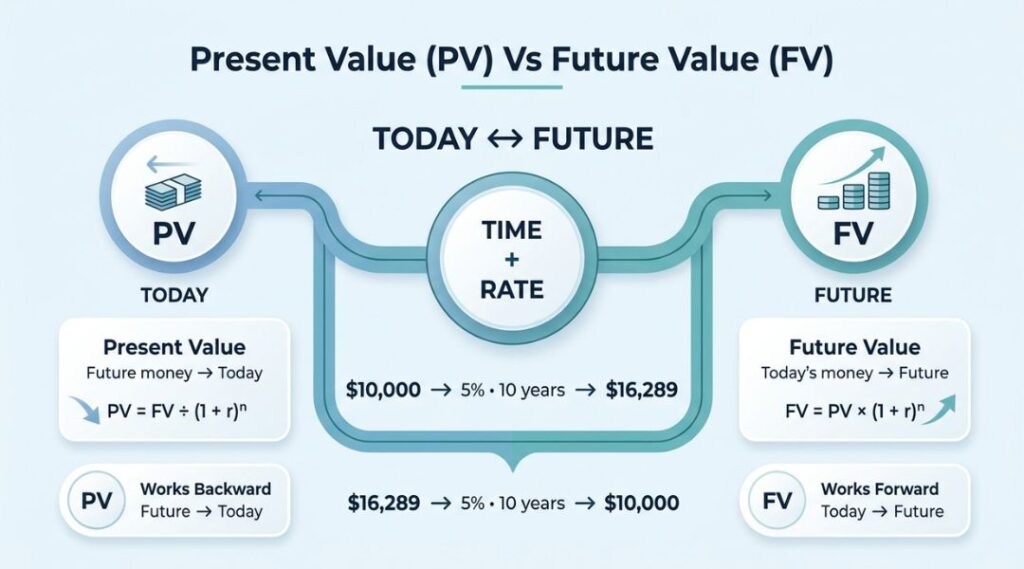
Present value and future value have two aspects of the same financial concept: that money has different values at different times.
Present Value (PV) Vs Future Value (FV) enables comparison of money today with money at a different date. These concepts are extensively applied to saving, investing, lending, saving for retirement, and other time-value-of-money calculations.
What Is Present Value?
Present value (PV) tells you what a future amount of money is worth today after applying a discount rate.
OpenStax defines present value as the current value of a future amount, calculated by discounting it over a specified period.
A common formula is:
PV = FV ÷ (1 + r)^n
Where:
- FV = future value
- r = interest or discount rate
- n = number of periods
PV is useful when you already know a future amount and want to work backward.
What Is Future Value?
Future value (FV) estimates what money today could grow to over time.
Investor.gov describes future value as the value of an asset at a specified future date.
The basic formula is:
FV = PV × (1 + r)^n
Future value increases through compounding, meaning previously earned interest can itself earn interest over time.
You can use a future value calculators to estimate how an investment may grow based on your starting amount, return, and time period.
Present Value vs Future Value: The Main Difference
The easiest way to distinguish them is by the direction of the calculation.
Future Value Moves Forward
You start with money today and calculate its potential value later. The result can also depend on how often interest is compounded, especially when comparing different investment assumptions.
For example, $10,000 growing at 5% annually for 10 years would have a future value of about $16,289.
Present Value Moves Backward
You start with a future amount and calculate its equivalent value today.
Discounting that same $16,289 back 10 years at 5% gives a present value of approximately $10,000.
In other words, PV and FV are mathematically connected.
When Should You Use PV or FV?
Use future value when you want to estimate:
- How savings may grow
- The value of an investment later
- Progress toward a future financial target
Use present value when you want to determine:
- What a future payment is worth today
- How much you need to invest now
- Whether future cash flows justify a current cost
One Detail That Matters: Your Rate Assumption
Both calculations depend heavily on the interest or discount rate you choose. Because the result depends on the assumptions you enter, it is also important to understand the limitations of future value calculations.
The greater the rate of growth, generally, the greater the future value. The greater the discount rate, the lower the PV. These effects are also amplified with the passage of time and hence the importance of realistic assumptions.
The Bottom Line
The key difference in Present Value (PV) Vs Future Value (FV) is perspective.
Future value asks, “What could today’s money become?” Present value asks, “What is future money worth today?”

An Accounting & Finance graduate currently pursuing an advanced Master’s in accounting and finance degree at Teesside University (UK), Anfal leads our rigorous quality assurance pipeline. She systematically audits the algorithmic calculations behind our tools, cross-checking every output against institutional benchmarks and academic financial literature to eliminate calculation drift.