
What Is the Future Value of 401(k) vs. Roth IRA Contributions?
What is the future value of 401(k) vs. Roth IRA contributions? Compare growth, taxes, contribution limits, employer matches, and retirement value.
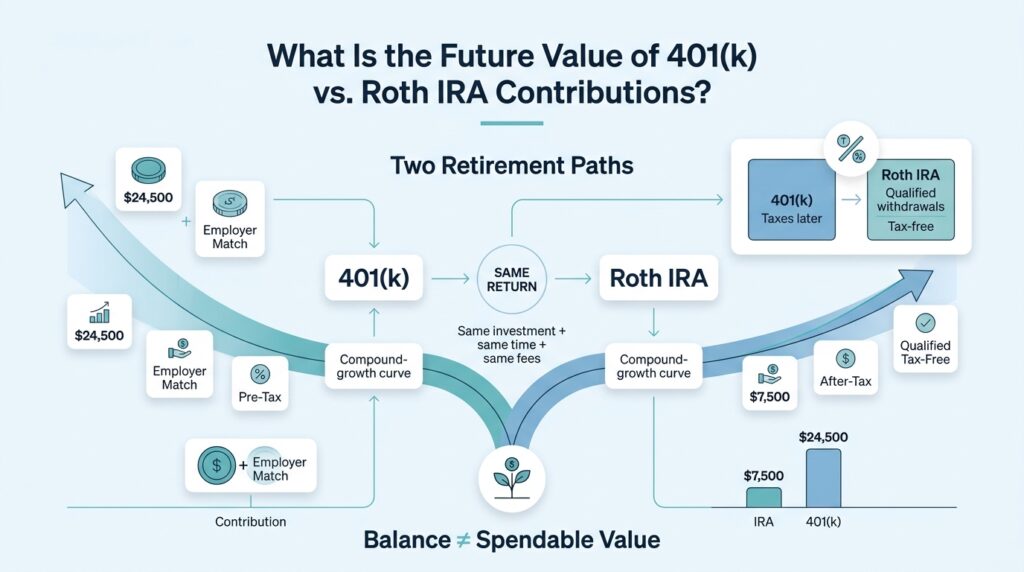
What Is the Future Value of 401(k) vs. Roth IRA Contributions? While comparing 401(k) and Roth IRA, it’s easy to get the question of which would yield a greater future benefit. The solution is not a clear-cut one-size-fits-all decision between the accounts.
Its mathematical future value will be the same if the same amount of money were invested for the same length of time yielding the same return with the same fees. What changes are the amounts you can contribute, amount added by the employer, and taxation on them.
This comparison is based largely on a traditional 401(k) plan compared to a Roth IRA for clarity. Employers may also provide Roth 401(k) plans.
How Future Value Is Calculated
Future value depends on factors such as:
- Amount contributed
- Investment return
- Time invested
- Contribution frequency
- Fees and expenses
The account label itself does not change compound growth. A $5,000 investment earning the same return for the same period grows identically before considering taxes and fees.
You can use a future value calculators to estimate how different contribution amounts, returns, and investment periods may affect the projected balance.
Why a 401(k) May Build a Larger Balance
Higher Contribution Limits
In 2026, employees can generally defer up to $24,500 into a 401(k), compared with a $7,500 combined annual limit for traditional and Roth IRAs. Catch-up limits may allow older savers to contribute more.
That higher ceiling can produce a much larger future balance if you actually contribute more.
Regular contributions can make a substantial difference over longer periods, as shown by the growth of monthly investments over time.
Employer Matching Can Accelerate Growth
Many 401(k) plans also offer employer matching contributions. Those extra dollars enter the account and have years to compound, potentially making the match one of the biggest differences between the two accounts.
Why Roth IRA Future Value Requires a Tax Perspective
Roth IRA contributions are made with after-tax money. Qualified withdrawals, including earnings, can generally be tax-free when IRS requirements are satisfied.
Traditional 401(k) contributions are generally made pre-tax, reducing taxable income when contributed, while withdrawals are generally taxable later.
This creates an important distinction:
Account balance is not the same as spendable retirement value.
A traditional 401(k) showing $500,000 may eventually generate taxes when withdrawn. A $500,000 Roth IRA could provide more after-tax spending power if its distributions are qualified.
Which Has the Better Future Value?
Neither account automatically grows faster. The better outcome depends on:
- How much you contribute
- Whether your employer provides a match
- Investment choices and fees
- Your current and future tax rates
- How long the money compounds
- Roth IRA income eligibility
These projections also have limitations because future returns, fees, taxes, and other assumptions can change the actual outcome. Understanding the limitations of future value calculations can help put these projections into perspective.
For 2026, Roth IRA contributions begin phasing out at specified income levels, so not everyone can make the full direct contribution.
The Bottom Line
So, what is the future value of 401(k) vs. Roth IRA contributions? If they are both given the same contribution, the same returns, the same fees, and have the same timing, then their investment growth before tax will be the same. Differences lie only in meaningful areas, such as contribution limits, employer matching, and taxation.
Think about how much cash gets deposited in a savings account and what portion of the total savings can be taken out after taxes. That is a much better comparison to consider when planning for retirement.

An Accounting & Finance graduate currently pursuing an advanced Master’s in accounting and finance degree at Teesside University (UK), Anfal leads our rigorous quality assurance pipeline. She systematically audits the algorithmic calculations behind our tools, cross-checking every output against institutional benchmarks and academic financial literature to eliminate calculation drift.